
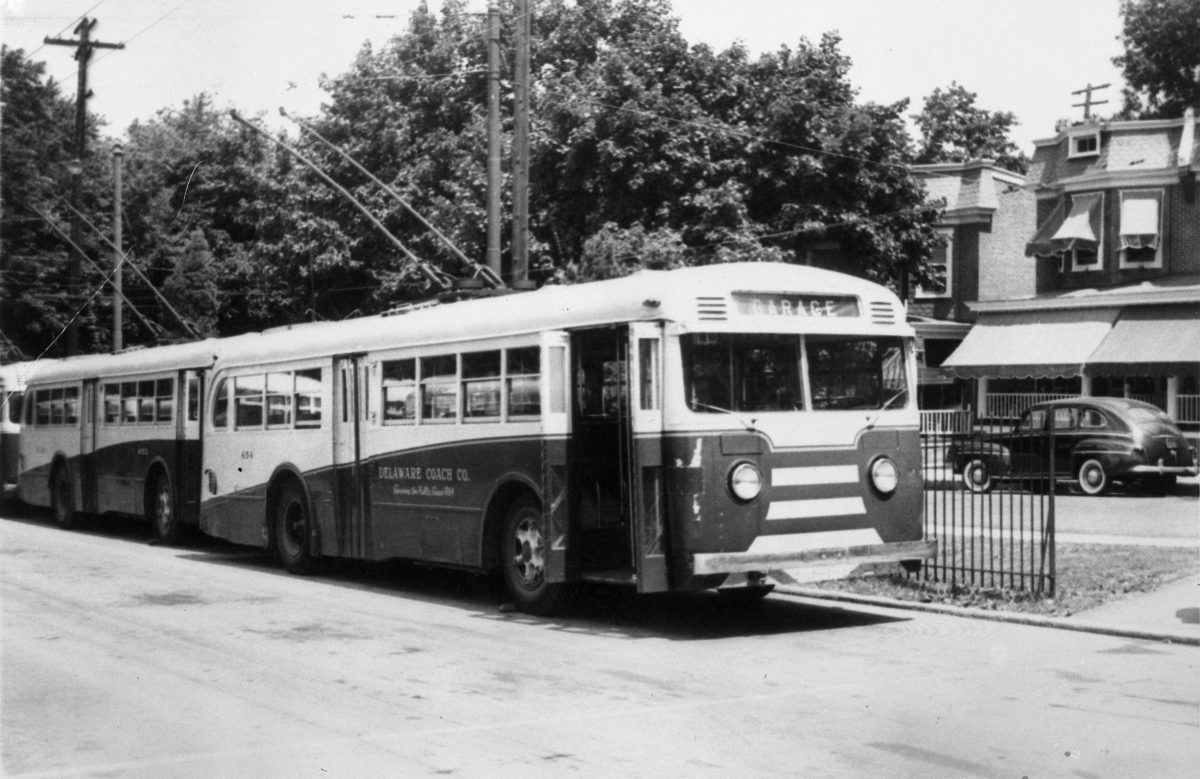
In 1966, Wilmington had one of the most disastrous public transit systems in the country. In the decades since ripping out their trolley tracks, most of the Wilmington metropolitan area was forced to rely on the services of the Delaware Coach Company, a private corporation which had long been notorious for its inconsistency and expense. Only the Public Service Commission offered any sort of regulation of the company, but no real attempts had been made to improve the condition of the buses in the state.
However, that was about to change. No individual politician or reformer would be able to defeat the stasis of the Delaware Coach Company. Instead, it would be the organized power of the Amalgamated Transit Union Local 842, the 175-member union which represented bus drivers and other workers within the Delaware Coach Company system. What began as a conflict over cost-of-living pay increases would become something much more. Throughout one of the longest strikes in Delaware history, the bus drivers of Wilmington would force a reckoning within the public transportation system and directly lead to the creation of DART, the publicly-owned company which still operates the buses to this day.
The Transit Amalgamation
Ever since the collapse of the Knights of Labor in the late 1880s, Wilmington had sported a modest, but adequate, labor movement. However, by the turn of the century, many of the city’s major industries were still unorganized. One of the most conspicuous absences was the trolley system. Like many other cities, Wilmington had developed a fairly extensive railcar system by the late 1800s, but it had never been organized by any union. The only check on the monopolistic private company was the Public Service Commission — one of a variety of commissions that ran the city and state governments. As opposed to the centralized departments that carry out public functions today, these commissions were appointed by the executive or legislative branch and managed by part-time staff or volunteers who largely got these positions as political appointments. It was a problematic system for an increasingly complicated city and state.
Workers eventually made their voice heard in this system. Streetcar strikes had become common in the Gilded Age, but prospective unionists didn’t find a proper organizational home until the 1890s, when streetcar drivers came together to form the Amalgamated Association of Street Railway Employees of America. After a wildcat strike in Wilmington in 1908, this union had briefly attempted to organize in the city, but nothing would stick until August 1918, when Local 842 of the Amalgamated Association of Street and Electric Railway Employees was officially established.1 The local was composed of workers at the Wilmington and Philadelphia Traction Company, the monopoly which ran all the trolley systems in the city. Though the right to collective bargaining had not been officially codified into law, Local 842 was able to negotiate a ten-cent raise and a 10-hour day in 1919, and the resulting fare increase was approved by the PSC.2
In the decades following that first agreement, the transportation system in Wilmington changed immensely. Beginning in the 1920s, personal automobiles became an increasingly dominant form of transportation, and the Wilmington and Philadelphia Traction Company was forced to adapt. In 1927, it changed its name to the Delaware Electric Power Co and began to phase-in trackless buses to replace its existing trolley lines. By the 1930s and 40s, the city was ripping out the trolley tracks entirely as the company signed a contract to become the sole provider of bus services in the city in 1938. Over these years, there was surprisingly little pushback from the union local, which transitioned from trolley workers to bus drivers. In 1949, a brief strike broke out over pay, but it was settled within two months with a six-cent wage increase.3
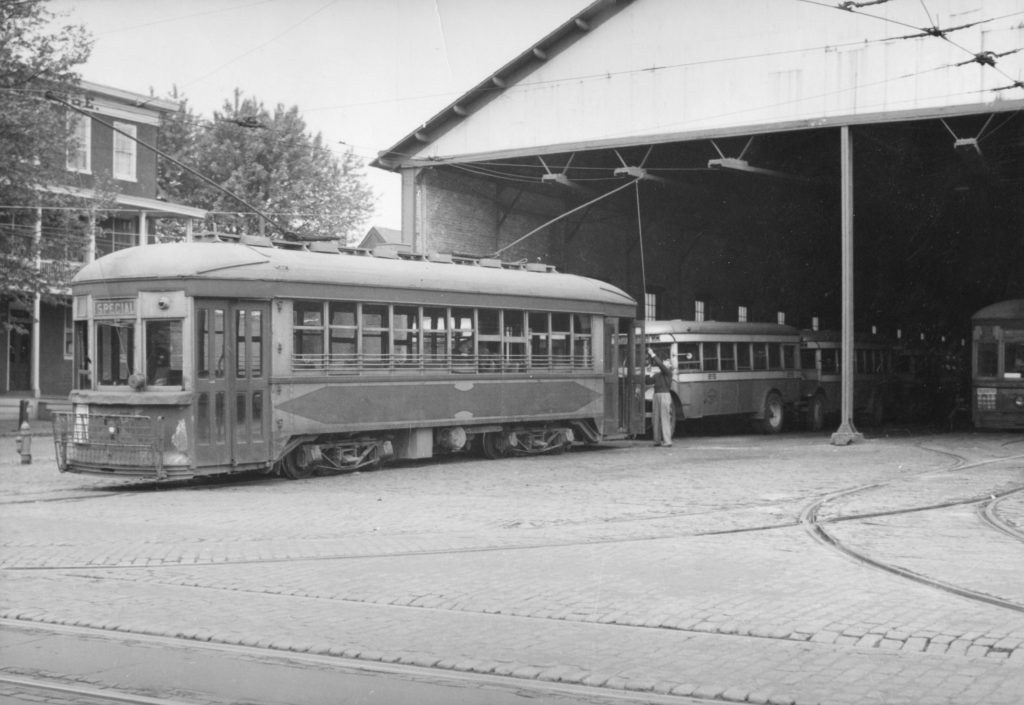
As the 1950s progressed, public sentiment began building against the public transit monopoly, which was now known as the Delaware Coach Company. Near the end of the decade, the company requested several rate increases before cutting back on services, angering both the union and the riders. In 1959, the city council launched an investigation into the company’s finances, leading the frustrated transit executives to offer to hand the city’s transit system over to the city to manage itself.4 The city did not bite; at this point, the municipal government was nowhere near well-organized enough to handle anything as complicated as a transit system. The controversy eventually fizzled out when the company refused to hand over their internal books to find a resolution.5
This was the status quo going into the 1960s. Management of the city’s transportation system was suspended between three groups: the Delaware Coach Company itself, which owned and operated the system; Local 842 of the newly-christened Amalgamated Transit Union (ATU), which ensured basic protections for its workers; and the Public Service Commission, which was in charge of managing rate increase and otherwise regulating the system. But it was not a status quo that was working. Nearly everyone involved agreed that something needed to change in Wilmington’s transit system, but no one was willing to be the one to make that change. It would take a shock to the system — one of the longest strikes in Delaware history — to force a change.
The 1966-67 Bus Strike
The Wilmington of 1966 was a much different city than it had been in 1949, the last time ATU Local 842 went on strike. Over those seventeen years, the city’s population had shrunk by over a quarter, as it would drop from around 110,000 in 1950 to just over 80,000 in 1970. While some of this population loss had been due to the draw of the suburbs — enabled by mass car ownership — the city itself had also begun a long decline. Poverty was spiking and communities were being hollowed out by failed redevelopment projects. At the same time, however, residents were getting organized. Dire economic conditions in the streets of Wilmington had mingled with the rising civil rights movement to inspire a new wave of organizations: tenant unions, community development groups, and even confederations of street gangs.
It would not take long for that same militancy to reach the bus drivers. Along with the dire economic straits of the city, the country was beginning to see the gradual rise of inflation that would become an epidemic in the 1970s. With their contract expiring on September 30th, 1966, ATU geared up for a fight. Bus drivers were paid $2.65 an hour ($27.15 in 2026 dollars), about double the minimum wage at the time, but they were looking to get a significant increase. Their previous contract in 1964 prior raised their pay by 15 cents over the course of those two years, but the final 5 cent increase had come 13 months before the end of the contract. Facing rising costs for food and housing, something more substantial would be needed for the drivers.
On the other side, the Delaware Coach Company was still not interested in making any changes to their gradually declining bus lines. The franchise was now owned by American Transportation Enterprises Inc., based out of New York City. In between the drivers and the owners were a number of elected officials — Delaware Governor Charles Terry, Wilmington Mayor John Babiarz, and New Castle County Executive William Conner all had a vested interest in avoiding a strike. Despite its decline over the prior decades, the bus system still moved over 500,000 people a year — including 3550 people every morning into downtown Wilmington.6
Although the contract ended on September 30th, Governor Terry was able to push both sides to delay until November. However, he was unable — even with the assistance of a federal negotiator — to get the company to raise its offer above 18 cents. Drivers saw this offer as a slap in the face, and at midnight on November 16th they officially went on strike. Buses slowly trickled back into the main garage, located in the modern day Trolley Square Shopping Center, and a picket line formed. For the next 176 days, no buses would run in and around Wilmington.
As far as Delaware strikes go, it was not particularly eventful. As the News Journal reported, the strike quickly fell into a “certain rhythmic pattern, with public officials providing the counterpoint.”
With each intervention by some public figure — the governor, the mayor, the county executive — the atmosphere would brighten and the two sides would sound optimistic. One side would seem to be giving in on some point. But just as quickly the other side would harden its position. A cloak of secrecy would be drawn around the negotiations and then would come the reports: The strike talks have collapsed.7
So it went for months. The main issue was the pay raise: the company refused to budge past 18 cents, while drivers asked for more than 20 cents. Any wage raise would inherently be controversial; to maintain their profits, the company would have to raise bus rates, which they could only do with approval from the Public Service Commission. However, as the strike dragged on, another issue arose. In March of 1967, the union began contending that American Transportation Enterprises was holding out so long in hopes of just selling out to some other company. While that may not have been the original intention, claimed ATU international vice president Walter Bierwagen, “somewhere along the way, a decision appears to have been made and selling became their primary consideration.”8 A local businessman revealed that the company was indeed negotiating to potentially sell the Delaware Coach Company to a local business syndicate.

This revelation changed the tenor of the strike. For so long, the status quo of the Delaware Coach Company seemed unmovable, but now a strike over simple wage increases created the opportunity for something new. Of course, that something new wouldn’t immediately become obvious. In April, the local businessman announced that their plan to buy the bus system had fallen through, leaving one feasible option: some sort of public takeover of the company. Later that month, the city and county both announced their willingness to sponsor a study looking into a metropolitan takeover of the Delaware Coach Company.9 The legislature was unwilling to take similar action, but enough momentum had now built around some sort of alternative that both sides softened.
After an ultimatum from Governor Terry and a last-ditch negotiation effort from Mayor Babiarz, an agreement was finally reached in the early morning of May 8th. The bus drivers would receive an immediate 15 cent raise, which would be followed by another 7 cents the following April — a total of 22 cents.10 The new contract was approved overwhelmingly by the union, and on Friday, May 12th, buses rolled out into Wilmington streets for the first time in 176 days.11 The strike was over, but the problems had still not been fully solved. Delaware Coach Company estimated that it had lost nearly a quarter of its ridership as a result of the strike, and would need to raise fares by 5 cents to cover the increased costs. Now the question would be — who will run the buses?
The Rise of DART
While the state had not acted explicitly before the end of the strike, the future of the bus system was already being debated. Delaware’s government in 1967 was quite divided. Democrats held the governor’s seat, Wilmington’s government, and the state senate; Republicans held the state house and the New Castle County government. Even before the strike had ended, both sides began to battle over what a future public transportation system could look like. Less than a week before the strike ended, a young Republican state representative named Mike Castle had introduced legislation that would have created a new New Castle County Transit Authority to acquire and run the Delaware Coach Company lines. Governor Terry introduced his own proposal: a state Department of Transportation that would be able to go into the bus business itself.12
By this point, the Delaware Coach Company was on its last legs. Facing a smaller ridership, the company had cut back their coverage by forty percent and increased fares. Their hope was that the company could be taken over by the state before the end of their contract with the union on April 30th, 1968, but political deadlock made that impossible. Terry’s proposed Department of Transportation was killed by Senate Republicans over the summer of 1967. After months of negotiation, he was able to introduce legislation with the approval of Mayor Babiarz and County Executive Connor creating a city-county transit authority that would loosely be placed within a broader state department.13
However, there was a catch: this authority would be run with funds provided by the federal government under the Urban Mass Transportation Act of 1964, and that legislation required that “before any financial assistance is provided, Labor shall certify that fair arrangements have been made to protect employees from losing any benefits or rights and to ensure that employees will not suffer from a worsening of their employment positions.” ATU Local 842 did not believe that the existing legislation did that.14 Eventually, after two more months, the labor component legislation was completely rewritten, ensuring continued union representation, and the union finally dropped their opposition.15 The bill passed both houses easily in April of 1968 — right as the riots and occupation of Wilmington began.16
The creation of this new system sparked a wave of optimism, even as the city suffered through one of its darkest chapters. The new Secretary of Transportation, Herbert Jervis, saw his job as “breaking up the love affair between man and his automobile.”17 He sought to completely restructure Wilmington’s transit system, bringing in the most modern equipment and expanding the service to reduce reliance on things like the brand-new I-95 which now cut through the middle of the city. Before taking on this public role, Jervis served as Director of Traffic for Hercules Inc, where he had been responsible for the movement of freight across the country. He now sought to bring the same basic idea to the city of Wilmington and the county more broadly.
Jervis was not the only figure with this sort of background and outlook. By the late 1960s, the business community in Delaware — especially within the Republican Party — had become more progressive than at any point in their history. They wanted to run the government like a business, but they didn’t mean that in the sense of stripping the state to its bones and selling off spare parts. Instead, they sought to rationalize the state — streamlining political commissions into professional departments to provide the best services to as many people as possible. No one better represented this growing trend in Delaware politics better than the new Republican governor who took over in 1969: Russ Peterson. While he was not originally from Delaware, Peterson had moved during WWII to begin working as a chemist at DuPont, and over the decades had risen to become a top executive and an influential figure within the Republican Party. He would be one of the most progressive governors in Delaware history, and one of the first things he would focus on was the state’s transit system.
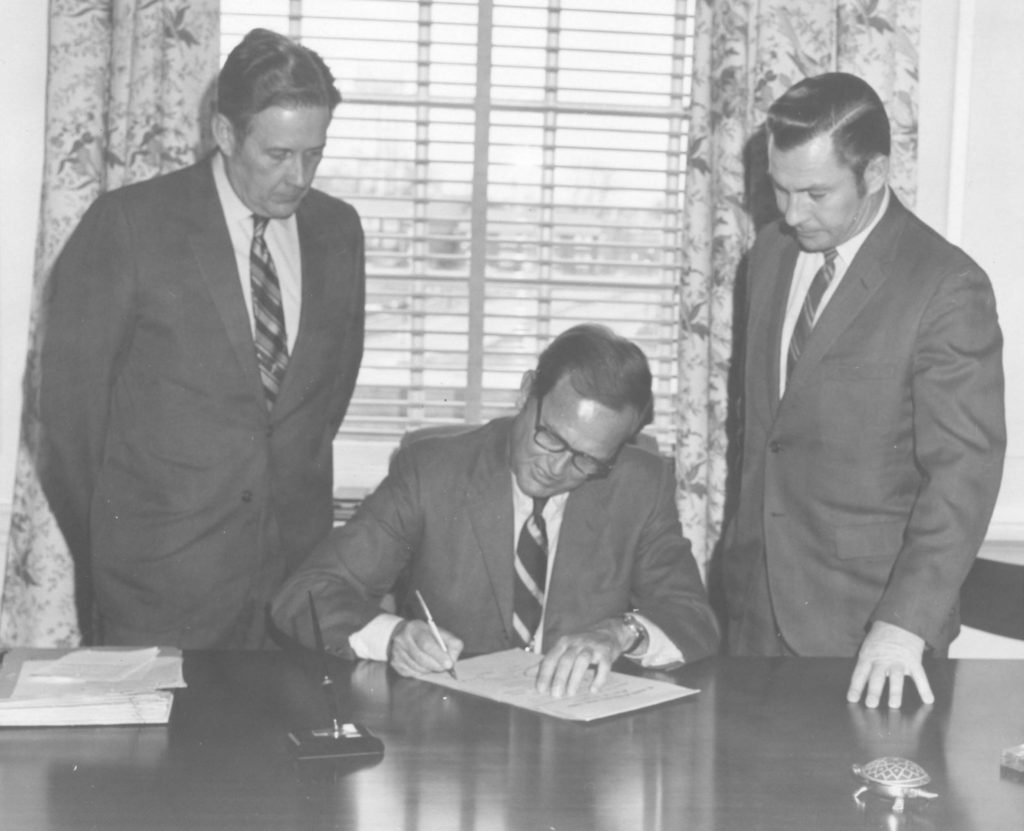
After the 1968 election but before Peterson took office, the newly created Greater Wilmington Transit Authority (GWTA) had finally taken control of the city and county’s bus lines.18 But lacking any support from the state, they had to take out a loan from the Bank of Delaware. Despite their financial woes, the new public transit authority slowly worked on restoring service to the routes that had been closed by the Delaware Coach Company.19 These efforts were boosted in June when Peterson signed a $1.35 million appropriation from the state to allow the GWTA to pay off its loan and buy new buses — which were now painted bright blue and yellow to announce their connection to the state.20
Under the new arrangement, labor relations within the bus system calmed down substantially. When Local 842 requested that the system move to require exact fares after several drivers had been robbed while handling cash, the GWTA responded quickly and made the change.21 When the existing union contract was set to expire at the end of 1969, the GWTA and Local 842 were able to find an amiable solution with no labor troubles — a 6.5-7.5% pay increase to deal with the continued rise in cost of living.22 In 1971, the union continued to support efforts to expand the bus system under its new name: the Delaware Authority for Regional Transit (DART).23 On DART Day that year, May 17th, attempted to get Delaware residents to take advantage of the new suburban lines enabled by state support.
For a while, it seemed that the new system was working. In 1972, DART announced that it had reached a new record in ridership: a 9 percent increase over the previous year, even as public transit was declining across the country.24 This trend was strengthened in 1973 when an international oil crisis caused many to abandon their previous driving habits, and DART continued to grow at three times the national average throughout the 1970s.25 After interest in the transit system had bottomed out from the transit strike and mismanagement from the Delaware Coach Company, it seemed that public ownership of the bus lines might be marking a turnaround in public transit for Delaware. So what happened?
Conclusion
It is difficult to point to one specific thing that has caused the most problems for DART in the nearly 60 years since it was created. As far as metropolitan bus lines go, it is still above average compared to other states, but it has fallen below its heyday in the 1970s. One clear culprit is a shift in the state of Delaware’s governing philosophy around public goods. During the 1970s, the business community shifted hard to the right, abandoning their belief in the government to bring about public good, and instead looking to deregulate and defund. Inflation was putting increased pressure on government budgets, and when Pete du Pont was elected governor in 1976, he made controlling the rising cost of government his number one priority. All levels of government began to cut their subsidies of DART, requiring it to increase fares and decrease routes. Despite another major oil crisis, DART ridership actually dipped in 1979.26
Luckily, a return to relative prosperity in the 1980s prevented DART from going under entirely. Ridership continued to hover over 5 million per year, though it did not grow substantially even as Delaware’s population boomed.27 It finally began to grow again in the 1990s, peaking at 7.2 million people per year in 2019. Then, the COVID pandemic struck and brought it down again. Ridership plummeted and inflation rose, requiring DART to make more cuts to service in recent years. As of Fiscal Year 2026, DART ridership sits around 6.4 million people per year. That is less than 30 percent higher than it was in the early 1970s despite the population nearly doubling in that time.
Much would be required in order to return Delaware’s public transit system back to its best days. The state’s car-focused development over the past fifty years has certainly not helped, and moving towards transit-oriented development would encourage more people to use buses and trains rather than driving wherever they go. Movement has been made within New Castle County to incentivize denser development that would allow residents to use the bus with less inconvenience.
However, the story of the 1966-67 bus strike and the creation of DART show another important ingredient: political will. For decades, Delaware’s bus system had been steadily degrading under the mismanagement of an absentee private owner. It took the coordinated action of organized bus drivers and the political will of the state government to force a new solution. When it became a priority, not only did the quality of the service improve and ridership increase, but workers were treated better and the city and state could take more pride in their public transportation system. We could do the same today, but the power concedes nothing without a demand.
Notes
- Car Strike Has Failed, The Morning News, Mon, May 18, 1908, To Hold Another Midnight Meeting, The Evening Journal, Thu, May 28, 1908
- Men Accept Terms; Traction Co Wants to Increase Fares, The News Journal, Fri, Aug 29, 1919
- Pact Ending Transit Dispute to Be Signed At Parlay Later Today, The News Journal, Fri, Jan 06, 1950
- Firm Willing to Lease or Sell Buses to the City, The News Journal, Fri, Apr 24, 1959
- Transit Firm Withholds Data, The Morning News, Fri, May 22, 1959
- Terry’s Plea Gains a Delay in Bus Strike, Bill Hayden, The News Journal, Sat, Nov 05, 1966
- 100 Days — And Still No Sign of the Next Bus, Ralph Moyed, The News Journal, Fri, Feb 24, 1967
- Bus Firm Wants to Sell, Not to Settle, Union Official Says, Bill Hayden, The Morning News, Fri, Mar 31, 1967
- Stat Abandons Bid to Restore Transit, Ralph Moyed, The Morning News, Fri, Apr 14, 1967, Stat Abandons Bid to Restore Transit, Ralph Moyed, The Morning News, Fri, Apr 14, 1967
- Pact on Ending Bus Strike Reached, Ralph Moyed, The Morning News, Mon, May 08, 1967, Crews Ready Buses To Roll, The News Journal, Tue, May 09, 1967
- Nice To Have You Back, Bill Hayden, The News Journal, Fri, May 12, 1967
- Bill Asked to Restore Bus Transit, Cy Lieberman, The Morning News, Wed, May 03, 1967, 2 Legislators Favor Terry’s Plan Despite The Bus Strike End, The News Journal, Tue, May 09, 1967
- Accord is Reached On Transit Measure, Ralph Moyed, The Morning News, Wed, Feb 21, 1968
- Union Talks Key To Bus Operations, Ralph Moyed, The News Journal, Wed, Feb 21, 1968
- Governor Unveils Transit Bill, Ralph Moyed, The News Journal, Wed, Mar 27, 1968
- House OK’s Mass Transportation Bill, Joe Distelheim, The Morning News, Thu, Apr 11, 1968
- Jervis’s Job: Parting Man and His Car, Ralph Moyed, The News Journal, Tue, Jun 25, 1968
- GWTA Takes Over Delaware Coach, The News Journal, Mon, Jan 06, 1969
- GWTA Would Up Bus Service, Add Express Trips for Arden, The News Journal, Tue, Apr 22, 1969
- House OK’s 1.35 Million for GWTA, The News Journal, Thu, Jun 19, 1969
- GWTA OK’s Call For Exact Fares, Bill Tudor, The Morning News, Tue, Oct 07, 1969
- Transit Pay Rise to Start Next Week, The Morning News, Wed, Feb 18, 1970
- Suburbs To Get Increased Bus Service May 16th, George Monaghan, The News Journal, Thu, Apr 29, 1971
- DART Rides Highest Since ’66, George Monaghan, The News Journal, Thu, Nov 02, 1972
- DART Has Riders—Its New Target Is Buses, Tony Davis, The Morning News, Wed, Dec 12, 1973, Should DART Get a Raise In Subsidies, Gerald Haugh, The News Journal, Sun, May 30, 1976
- Planners Aplenty Peer Into DART’s Smoggy Future, Nan Clements, The Morning News, Sun, May 21, 1978, DART Must Now Renew Riders’ Confidence, Nan Clements, The Morning News, Thu, May 31, 1979
- Take the Bus, The Morning News, Mon, Nov 16, 1987