
What is the best tent for homeless people?
This question became central to the City of Wilmington’s efforts to maintain a sanctioned encampment at Christina Park. Even now, after the City has put up 45 upgraded, uniform tents on wooden pallets in an orderly set of ranks and files, the question remains relevant. Answering this question reveals how the City, with its operating partner Friendship House, will oversee this encampment and the pitfalls that await.
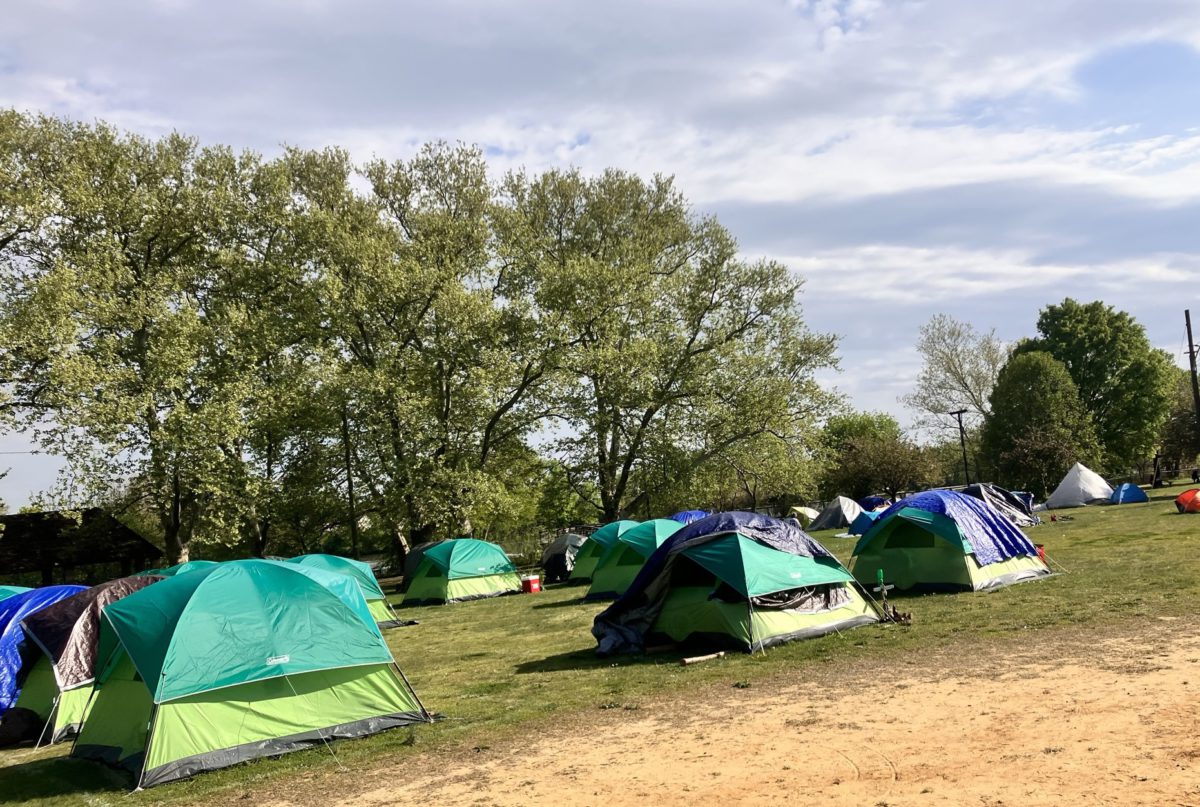
The homeless encampment at Christina Park was a growing assortment of colorful tents sprawling across the park’s lawn last fall when the City resolved to sanction the camp. In doing so, the City made it the centerpiece of a policy that relegates the city’s homeless to what I have argued is a “new skid row,” an enclave walled off from the rest of Wilmington by the Christina River on one side and the Amtrak viaduct on the other. In early April, the City moved to replace the existing jumble of tents with the grid of standardized tents. According to Cerron Cade, the City’s Chief of Staff, doing this represents transforming the camp into something “more aesthetically acceptable than … the random scattering of tents .”
Here Cade prioritizes aesthetics over lived experience. The question for the City was not which tent is best, but which tent looked best. And it left that decision to City personnel. Neither Friendship House nor camp residents publicly indicated any need to reconfigure the layout or supported imposing a grid.
With this combination of top-down vision, unilateral approach, and inexperience, the City proceeded to bungle the tent selection. The tents it initially purchased were billed on Amazon as being suitable for “camping groups, immigrants, disaster relief [and] homeless people,” and sold in a 5-pack for $205. The tents did not, however, come with a rain fly. Residents who moved into those tents on the first day were drenched, along with their belongings, in an overnight storm. In response to the outcry, the City bought new, green “weatherproof” tents and tarps that now stand in uniform rows of 15-by-15-foot plots with a walkway between each row.
Prior to this tent escapade, the encampment was left largely to fend for itself. The City limited its direct involvement to providing garbage pickup and portapotties, and Friendship House maintained only a minimal presence after business hours. In that vacuum, a loose group of five or six residents emerged as an informal governance structure.
These men have extensive experience with homeless services, though always on the receiving end. Most are older; several have done long stints in prison. Their authority comes from accumulated street knowledge and a willingness to protect residents made more vulnerable by age, gender, or disability.
These men maintain a basic level of order in the park. In providing safety, they were doing work Friendship House was nominally contracted to perform. They organized impromptu cleanup crews, kept tabs on who was new and who needed help, and brought residents together for cookouts or, in the cold, around a fire.
However, these efforts have limits. Many residents have long histories of homelessness and manifestations of mental illness, substance use, and trauma. This mix underlies a steady succession of arguments, threats, and erratic behavior. When situations escalate, the informal leaders are understandably reluctant to either intervene directly or call the police. Their tools for restoring order are few and, in extreme cases, are often reduced to expelling the person causing the disruption.
Alongside this loose governance, residents also found safety in smaller groups that organize the camp into distinct tent clusters. These clusters provide the social architecture that makes the encampment livable. People within a cluster bond through friendship, kinship, or the need for protection, maintaining larger tents for sleeping and smaller ones for storage. Many clusters have common areas, featuring amenities such as a few chairs, a burn barrel or grill, sometimes even a generator with extension cords running to nearby tents. Residents pool resources, watch over one another’s belongings, and provide companionship. But these alliances are fragile and easily strained by the pressures of living in deprivation while wrestling with personal demons.
For many longterm residents, their tents are a point of pride—something they invest in and adapt by building pallets and layering construction wrap, plastic sheeting, or even ad banners for waterproofing and insulation. These tents are large enough to accommodate partners or companions. Smaller, adjacent tents are used for storage. There is both a physical and a social order amidst the “random scattering of tents” that Cade decries.
With the clusters now coexisting alongside the grid, Christina Park no longer contains a single encampment but two overlapping ones—a tale of two tent cities. Each has its own logic and represents a competing set of priorities and lived experiences. The clusters consist mainly of longer-term residents who have resisted the move onto the grid because it makes no sense to them to do so. The new tents are smaller and flimsier, and the grid tents are too close together, offer no choice of neighbors, and sit on lots too small to hold their possessions. In contrast, newer arrivals—often lacking quality tents or experience maintaining them—readily accept a tent on the grid and appreciate the shelter they previously lacked.
Presently, the grid is full. Since the City began erecting tents, the number of people staying at the encampment has roughly doubled, climbing to approximately seventy, with about two-thirds living on the grid. Set up tents and, as the weather warms up, people will come. Set them up closer together and there will be more room to grow. Set them up without creating a pipeline to housing and the camp will fill like a stoppered bathtub.
The City has ordered those in the clusters to move onto the grid, but there is no room on the grid to accommodate them. Thus those who prefer staying in a cluster remain there, where they maintain the established order. They avoid the grid area. For them, the clusters contain familiar faces and established norms, while the grid is packed with strangers living too close together. The City set up this grid, their reasoning goes, so the City should watch over it. But while Friendship House has outreach workers at the camp during daylight hours, the grid is unattended at night.
Mixing together a growing population, increased density, and insufficient oversight is a recipe for disorder. Conversely, a path out of this spiral lies in living out Friendship House’s mission of “uniting people facing homelessness with loving, supportive communities they can call home.” This starts with recognizing the community that already exists. It then extends to working together with the camp residents to grow and reunite the community, while making the park’s environment more hospitable, easing the adversity of encampment life, and ultimately increasing the pipeline to permanent housing.
Supporting the camp’s existing selfgovernance efforts, and extending it to the entire camp is key to this. Incorporating residents’ lived expertise to expand Friendship House’s presence would make oversight more effective and the camp safer and cleaner. Funds the City has already earmarked for “overnight coverage” could pay residents for their work. This is loving and supportive, as well as practical and costeffective. Listening to residents could have kept the City from choosing leaky tents; it can now help keep the camp a viable community.
Stephen Metraux is a professor of public policy at the University of Delaware.