
One of the New Castle County Police Department (NCCPD) officers involved in the fatal shooting of Lymond Moses is once again involved in a lawsuit that alleges use of force.
Officer Sean Sweeney-Jones is named as a defendant in an ongoing civil lawsuit stemming from the November 21, 2022, arrest of Trynity Hood-Anderson. The lawsuit alleges Sweeney-Jones “forcefully grabbed, pushed, punched, tackled, and/or otherwise struck [Hood-Anderson] prior to and while she was in the holding cell” at the NCCPD headquarters.
Hood-Anderson claims she suffered injuries, including “facial contusions, cervical strain, blunt head injury, and contusion of her hip,” and was “forced to stay in the holding cell without proper medical care” before going to ChristianaCare Hospital later that day. She sought treatment for headaches one month after the incident.
On January 13, the U.S. District Court of Delaware upheld the claim against Sweeney-Jones for his alleged “use of excessive force” during the arrest, while dismissing several others, including all claims against Vaughn M. Bond Jr. in his capacity as the director of the Department of Public Safety that oversees the NCCPD.
Sergeant Andrea Botterbosh of the NCCPD Public Information Office said that since the lawsuit is in active litigation, both the department and Sweeney-Jones “would be unable to provide interviews or comment.”
The killing of Lymond Moses
Sweeney-Jones was one of the three responding officers on the night of January 13, 2021, when he and Officers Roberto Ieradi and Robert Ellis were patrolling the Riverside neighborhood in Wilmington looking for stolen vehicles.
They encountered Moses resting in his car and began questioning him. Body-worn camera footage shows an unarmed and visibly panicked Moses driving off and stopping at a dead end on Rosemount Avenue. The officers follow in pursuit, and Sweeney-Jones stops his patrol SUV closest to Moses’ car, by then facing the officers. He begins to flee in their direction, and Ieradi fires seven shots at Moses, and Ellis fires two. One of Ieradi’s shots struck Moses in the left side of his head as he drove past Ellis, causing him to crash. He was pronounced dead at the scene.
Moses’ death made international headlines, sparked protests, and prompted renewed calls for police reform. Multiple local, state, and independent investigations were undertaken, and the family of Lymond Moses sued New Castle County and the officers involved, including Sweeney-Jones. It was settled for over $1 million in 2023.
All three officers were cleared of criminal wrongdoing, and Ieradi left the department. Later, it was reported that they had been suspended for between “4 to 16 hours” and Sweeney-Jones had been disciplined for “not activating his body camera at the start of the interaction with Moses.”
Another report noted that “when asked if he’d ever been suspended before the Moses shooting, Sweeney-Jones said he believed so.”
Cops and robbers
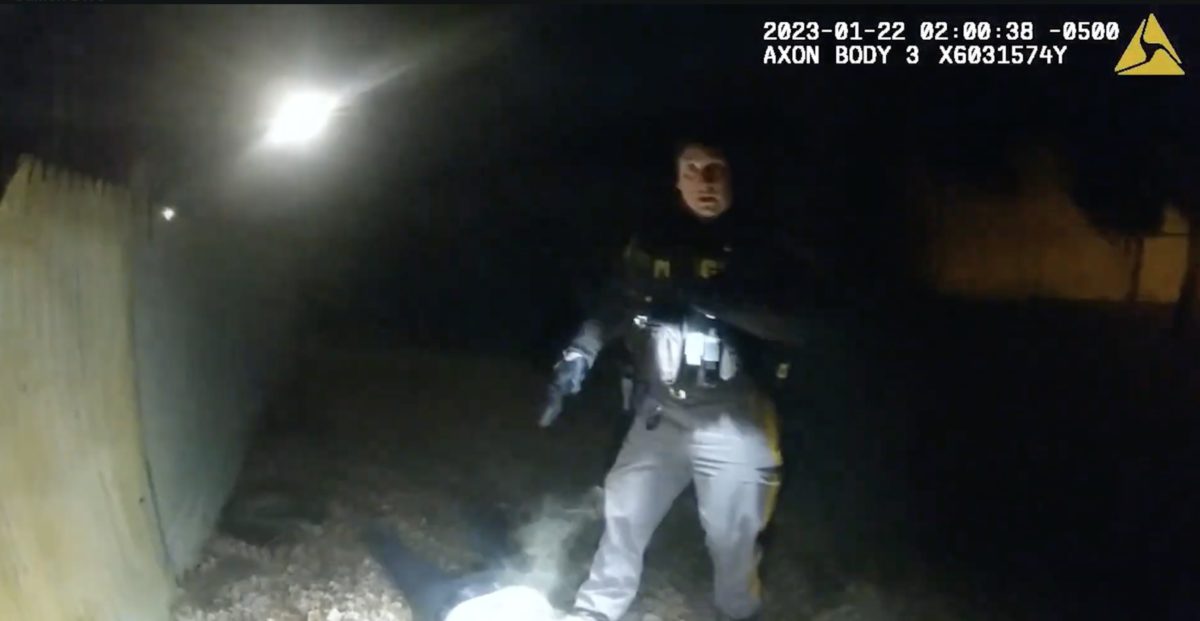
Sweeney-Jones did not fire any shots at Moses that night. But just over two years later, on January 22, 2023, he and three other officers were involved in another incident that resulted in an investigation into the use of force when they responded to a call from inside 21 West Minuit Drive in New Castle.
The caller said that intruders had broken into the house and were attacking his roommates, reads the investigation report. He “advised he was in his bedroom and could hear commotion and yelling from the living room.”
Body-worn cameras captured the vantage points of all four officers – Sweeney-Jones, Officers Kourtney Kluczynski, Ryan Archangelo, and Alejandro Guillen. Sweeney-Jones is the first to approach the house, flanked by Kluczynski and Archangelo, while Guillen follows behind. Sweeney-Jones attempts to peer into the house through a window and then moves toward the front door and turns on a flashlight.
At that moment, two masked men, Evan Chandler and Alistair DiPasquale, emerge from the house. DiPasquale can be seen carrying a large MP5 rifle, and Chandler is holding a bag. Each officer is heard yelling commands before Chandler turns around to face the officers. When neither man complies with the orders, Sweeney-Jones and Archangelo begin firing, and both drop to the ground. Guillen proceeded to the back of the house, where he fired one shot toward David Salasky as he was trying to scale a wooden fence and flee.
Chandler, DiPasquale, and Salasky were each treated for non-life-threatening injuries, while a fourth intruder, Michael Edgerton, was later apprehended. All four officers were cleared of any criminal wrongdoing.
Keith Price is down
It marked the third time Sweeney-Jones had been investigated for use of force. The first came six years prior, when he shot and killed Keith Price on April 19, 2017, in Wilmington.
A warrant for attempted murder had been issued for Price’s arrest, and, according to the investigation report, Price had told a witness, “he would rather die than go back to jail.”
Two detectives observed Price in his car, and one parked an unmarked car behind him and called for assistance in apprehending him. Sweeney-Jones was one of the responding officers, and when Price saw the marked patrol cars, he reversed into the detective’s car and drove off. A detective shot at the fleeing car, hitting it on the passenger’s side door and center console.
Price was pursued by Sweeney-Jones before crashing into two other cars at the intersection of Philadelphia Pike and the Washington Street Extension. Price fled on foot, and Sweeney-Jones chased him towards Saint Helena’s Church.
Body-worn camera footage that has not been reviewed by the Call apparently shows Price running behind tall bushes before remerging “slightly turned toward Officer Sweeney-Jones, with his right hand up” and extended, appearing to hold a gun. The body camera did not record commands issued by Sweeney-Jones or the sound of a shot fired by Price; a ballistics examination later revealed a spent casing from the gun found underneath his body.
Sweeney-Jones fired eleven shots at Price, hitting him “seven times, specifically through the neck, torso and upper extremities.” He fell forward on the pavement, where “blood is then seen pooling under Mr. Price’s body.” He lifted his head and looked around, then died outside the church. Sweeney-Jones told investigators that he had “fired from the moment he heard a gunshot until Mr. Price was down.”
Sweeney-Jones was placed on paid administrative leave for two weeks following the incident, and then “took two to three more months off” until he was “ready to come back.”
Making the list
Sweeney-Jones has never been charged with criminal wrongdoing. Instead, the Price shooting marked his first of two appearances on the Police Use of Force Investigations list maintained by the Delaware Department of Justice Division of Civil Rights and Public Trust (DCRPT).
DCRPT did not respond to repeated inquiries as to whether it was undertaking an investigation into the Hood-Anderson use of force allegations, or if the investigations list should include Sweeney-Jones and Ellis’ names, along with Ieradi, where it cites the Moses incident.
The investigation reports make clear that police departments are responsible for “establishing and enforcing guidelines for the use of force by their officers” and that the DDOJ only steps in to determine if the use of force constituted a criminal act and there’s a chance of conviction, while the Police Officer Standards and Training Commission (POST) “oversees all standards and training for police officers in Delaware.”
The NCCPD policy on use of force outlines directives for officers and, if the officer’s actions are deemed “beyond objectively reasonable under the circumstances” or “excessive,” an internal investigation results. It does not stipulate whether there is a protocol in place for when officers have been investigated multiple times. Assistant County Attorney for the New Castle County Office of Law, Colleen Norris, did not issue a comment, citing ongoing litigation.
Both the Lymond Moses and Hood-Anderson lawsuits claim that Sweeney-Jones and other officers involved received inadequate training by the NCCPD. The results of the Moses investigation recommended several areas of police training reform for the department to undertake, including de-escalation tactics and discouraging a “shooting until the problem is solved” mentality.
Sweeney-Jones was there when nine shots were fired at Lymond Moses, at least fifteen at Evan Chandler, Alistair DiPasquale, and David Salasky, and eleven at Keith Price. And those are the shots we know about.